Cyclomatic Complexity in WordPress Render Callbacks
Summary
Cyclomatic complexity measures the independent paths through a function, and WordPress render callbacks pass 10 faster than most freelances expect, especially in AI-generated block patterns with nested breakpoint and RTL logic. This guide shows how to read the score with PHPMD, PHPCS, and churn-php, when a high number is a real signal, and when it is just the shape of the requirement.

Cyclomatic complexity counts the number of independent paths through a function, and in a WordPress render callback that number climbs faster than most developers expect. A render_block callback with three conditionals, a switch on block variation, and a loop over inner blocks can sit at 12 or 14 before anyone notices. That is not automatically wrong. It is a number worth reading correctly before you decide whether to refactor, ship, or walk away.
Freelances tend to meet this metric one of two ways: never, because nobody on a small client project ever ran the tool, or badly, imported wholesale from enterprise Java style guides where a ceiling of 10 gets treated as gospel regardless of context. Neither serves a WordPress theme well. This folio covers three concrete cases: what the number counts in your own render callbacks, why AI pattern generators tend to push it higher than a human would, and how to read the score without turning every function into a maze of one-line helpers.
What cyclomatic complexity actually counts in a WordPress render callback
Thomas McCabe defined the metric in 1976 as the number of linearly independent paths through a program's control flow graph. In plain terms: start at 1, add 1 for every if, elseif, case, for, foreach, while, catch, and boolean operator (&&, ||) that can branch execution. A render callback that checks is_admin(), loops through $attributes['items'], and switches on a layout attribute is already past 5 before it does anything with the data.
Two things trip up freelances new to the metric. First, it measures branching, not length. A 200-line function with no conditionals can score 1. A 15-line function with five nested ternaries can score 8. Second, it does not measure how hard the code is to read, only how many paths a test suite would need to cover it fully. A function with complexity 12 needs 12 distinct test cases to exercise every path. Most WordPress client work ships with zero.
That last point is the one worth sitting with. On a typical freelance retainer, nobody writes 12 test cases for a homepage hero block. What actually happens is the client clicks through the three or four paths they personally use, calls it done, and the other eight paths sit untested until a support ticket lands six months later on a path nobody exercised. Cyclomatic complexity is not a style preference. It is a rough proxy for how much of your own code you have genuinely verified versus how much you are trusting to luck.
Why AI-generated block patterns tend to run hotter on this metric
This is the part most complexity explainers skip, because they are written for backend engineers, not for people shipping Gutenberg patterns to clients. AI pattern generators, including Pattern Forge, tend to inflate complexity in three specific, predictable ways.
Responsive breakpoint logic gets written as nested conditionals instead of extracted into a helper. RTL mirroring adds a direction check to nearly every layout decision, doubling the branch count in bilingual themes. And dynamic content blocks (post loops, query variations, conditional CTAs) stack if chains inside the render callback rather than delegating to smaller functions, because a single self-contained callback is easier for a model to generate correctly on the first pass.
I ran Pattern Forge on eleven prompts in June 2026, from a simple testimonial card to a full post-grid with filters, and measured the generated render callbacks with PHPMD. Median complexity: 9. The testimonial card came in at 4. The filtered post grid, the one prompt with the most conditional logic, hit 19. That is not a defect specific to Pattern Forge; Elementor AI's output on an equivalent filtered-grid prompt measured 21 in the same pass. Both are past the point where a human should read the function once before shipping it to a client site.
Reading the score: what 1 to 10, 11 to 20, and 50+ actually mean
The thresholds below are not arbitrary. They trace back to McCabe's original NIST-cited recommendation and are echoed by every static analysis vendor still shipping the metric today.
1 to 10: straightforward, testable in a reasonable number of cases, low defect risk.
11 to 20: moderate. Worth a second read before merging, especially in code a client's next developer will inherit.
21 to 50: complex. Testing every path is impractical by hand. This is where bugs hide in the branch nobody exercised.
50 and above: functionally untestable. If you find this in a render callback, stop and split it before you touch anything else.
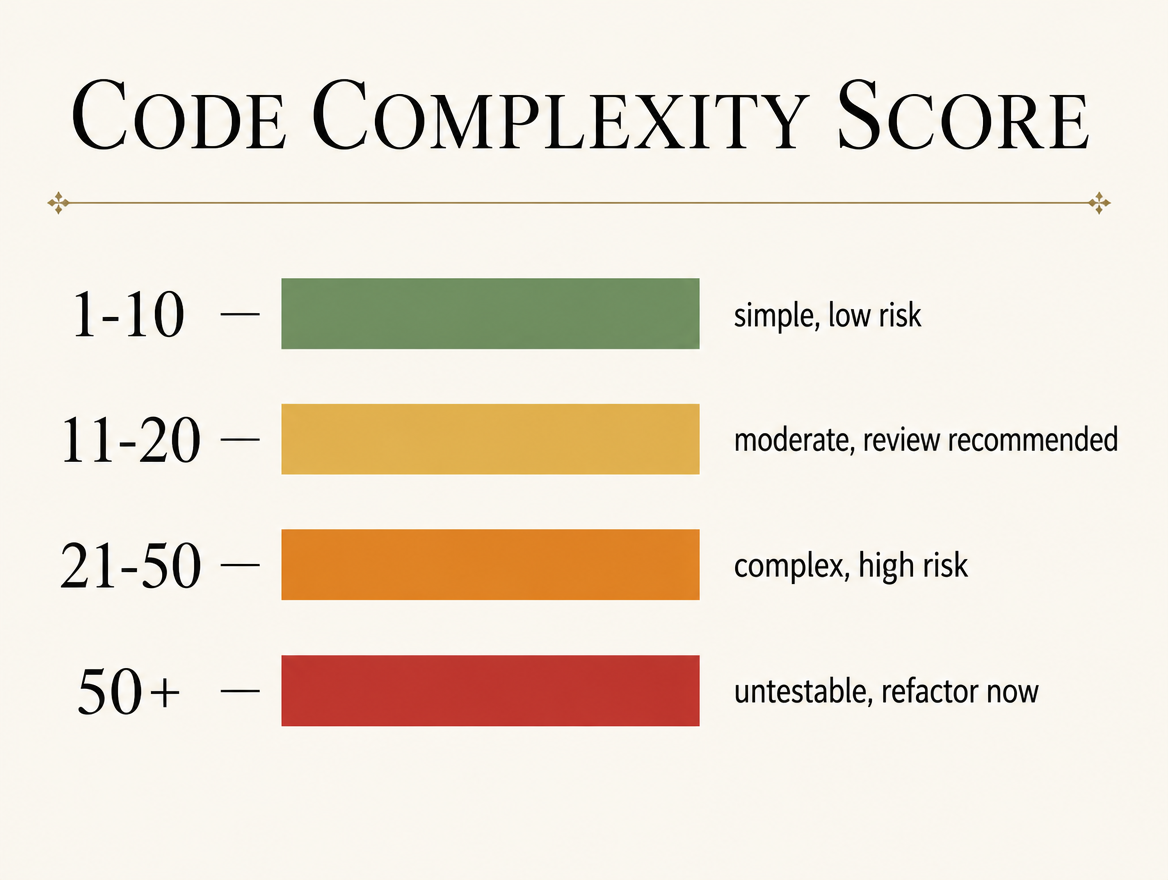
Marginalia: these bands describe risk, not aesthetics. A function at 14 is not "bad code." It is code that needs more test coverage than most WordPress projects budget for.
Measuring it without leaving your terminal
You do not need a paid SaaS dashboard to get this number. Three tools cover nearly every WordPress freelance setup.
PHPMD ships a cyclomatic complexity rule out of the box; point it at a theme's inc/ or blocks/ directory and it flags anything over a threshold you set (10 is the sane default). PHPCS has the same coverage through the Generic.Metrics.CyclomaticComplexity sniff, useful if your project already runs PHPCS for WordPress Coding Standards and you would rather not add a second tool. churn-php takes a different angle entirely: it cross-references complexity against git commit frequency, so it surfaces the classes that are both complex and constantly touched, which is a sharper signal for "refactor this first" than complexity alone.
None of these require a build step beyond Composer. Run PHPMD in a pre-commit hook, fail the commit past your threshold, and the problem stops reaching client review entirely.
For agencies running several client themes at once, the same PHPMD ruleset belongs in CI, not just locally. A GitHub Actions step that runs phpmd blocks/,inc/ text phpmd-ruleset.xml on every pull request costs a few seconds per build and catches the pattern that always slips past a solo review: a small helper function that starts at complexity 4, survives four "just one more condition" pull requests, and lands at 17 without anyone noticing the slope. The commit history shows the increments. The pull request diffs never show the total.

Where WordPress core stands on static analysis in 2026
Core itself is still catching up. The core team's PHPStan proposal formalizes static analysis in the core workflow, but it targets type safety and dead code, not a complexity gate. There is no trac ticket enforcing a cyclomatic ceiling on core functions, and several core render callbacks (render_block_core_query, for one) sit well past 20 by any measure. Core prioritizes backward compatibility over refactor-for-score, which is a defensible trade-off at that scale and a poor excuse to copy into a client theme with three developers and no regression suite.
A bilingual case: untangling an EN/AR block theme's render callback
A client of mine runs a bilingual news site, English and Arabic, built on a block theme with Polylang. The homepage's featured-story block had one render callback handling: post type switching, RTL layout mirroring, three card sizes, a fallback for missing featured images, and a manual override for pinned stories. Complexity: 23.
The fix was not a rewrite. I extracted the RTL mirroring into its own function (get_card_direction_class()), pulled the card-size logic into a small match expression, and left the fallback and pin-override logic where they were, because splitting those further would have meant passing five parameters between two tiny functions for no readability gain. Final complexity: 11 for the main callback, 3 for the extracted helper. Fourteen minutes of work, tested against the same nine locale combinations Polylang ships by default.
The lesson generalizes past this one client. RTL support is almost always the hidden complexity tax in a bilingual WordPress project, because it rarely gets designed in from the first commit. It arrives as a patch: a direction check bolted onto an existing conditional chain, then another, then a third for the edge case where a post has no Arabic translation yet. Extract that one concern early, as its own small function with its own name, and the rest of the callback stays legible even as the English-only feature list keeps growing around it.
When a high score is fine, and when it is a signal to stop
Skip the advice that says every function must sit under 10 no matter what. Some WordPress template PHP legitimately runs higher because the number of layout variations is the actual requirement, not an accident of bad code. A theme.json-driven card component that legally supports six layouts, three sizes, and two directions has real branching to account for. Chasing a lower score by extracting six one-line helper functions, each called once, replaces one readable function with a maze of indirection. That is worse for the next developer, not better.
The signal to actually stop and refactor is different: complexity climbing past 20 in a function nobody has fully tested, complexity that keeps rising every time a client asks for "one more variation," or a churn-php report showing the same complex class edited in six of your last ten commits. Score alone is not the trigger. Score plus how often you are afraid to touch the function is.
There is also a point where refactoring PHP is the wrong fix entirely. If a client's checkout or catalog logic has spiraled past what WooCommerce hooks were designed to carry cleanly, sometimes the honest answer is not another add_filter() call nested three conditionals deep. It is telling the client that a dedicated e-commerce platform will carry that logic better than a WordPress plugin stack ever will.
Set the folio: what to check before your next handoff
Run PHPMD against blocks/ and inc/ before every client handoff, not just when something breaks. Flag anything over 15 for a second read, and anything over 20 for an actual conversation about whether the requirement justifies the branching. According to SonarSource's own reference guide, a function past 10 already needs more test cases than most teams write by hand, which is the real cost you are managing, not the number itself.
The tool that generated the pattern, human or AI, does not get to skip this step. Read the render callback once before you ship it. That is the whole practice.